The Opportunity of “Keywords Not Provided”

music neon letters
Photo Credit: [phil h]
The world of Search Engine Optimization is being rocked again by Google. With most searches now being done securely over the HTTPS protocol, some valuable referral data is being lost by traffic analysts. Now there is no way to know whether a visit to a certain page, coming from Google, is due to a search about X or about Y or Z. We can easily know we have visits to certain pages, and we can estimate how our pages are ranking, but not what kind of searches our visitors were doing exactly.

There was a lot of commotion about this, but there’s no point in resenting Google nor even eagerly gathering keywords another way. The truth is that referral keywords are overrated because they lead to optimizing for search visibility instead of goal completion (user conversion). Why? Because you only get data for stuff that is ranking.

It’s time to look ahead and realize that the fixation on keyword data is actually restrictive and blocking the evolution of Search Engine Optimization. Professional SEOs need to adapt in order to remain in business, but not on a wild goose chase of keyword data, wasting valuable time trying to micro-manage Web Analytics. Instead, the same time could be applied on actually improving the site, its popularity and (consequently) its backlinks.

Then what should be done on the Analytics side?

  • Predictive research is of the utmost importance. Getting keyword research done thoroughly beforehand. Investigating all possible searches that users are doing and that aren’t too competitive to rank for.
  • When unsure about focusing your pages on keywords X or Y, we can always make small changes later and test their impact. Instead of working passively, based on what we think our Analytics software told us to do, we work actively and measure the traffic impact later.
  • Optionally use AdWords with broad queries and specific keywords, in order to test which specific keywords drive more goal completions. Some say we’re falling prey to the conspiracy theory that Google is driving us to spend more in AdWords, but the truth is… it’s a great method to choose from a few specific keyword variations that we identify in predictive research. It can be done much quicker and probably with less chance of skewing than using Analytics for this purpose.

But what really, really matters?

SEOs should already be broadening their perspective and strategies, even before today, and now more so. We should all view Search Engine Optimization, Search Engine Marketing, general Online Marketing and Social Media Management as a holistic field that can be explored for the benefit of clients. The goal of any of these marketing sub-fields is to make your clients richer, more successful. Not simply to make them visible to search engines and people. For this, an online strategy should have multiple defined goals for the business it applies to, and performance indicators to evaluate the effectiveness of that strategy at some point.

Now, with keywords not provided, the experience of good SEOs becomes invaluable because they know what works… this at a time where it’s more difficult to prove what works. So, the future is in the hands of those who know what they’re doing and are confident in their abilities to drive targeted traffic. More than ever, reputation and experience will be key values, and so will be the ability to convince clients about the added value of our SEO.


Basic Tips for Privacy on the Web

In the light of recent news about N$A practices, you may wonder how to take a little more control of your Web presence and experience. Here are some steps to consider if you value privacy…

Email:

  • Make sure the connection to your email provider/server is a secure connection. Webmail providers (those where you check your email in your browser) usually are. Others (server-based) should be double-checked to be using SSL/TLS connection.
  • If you’re in Europe, consider using an European provider, such as ProtonMail.
  • For an additional security layer, if you’re not using ProtonMail, consider encrypting your messages. Thunderbird users can use the Enigmail add-on. For Webmail, there are some browser extensions for encryption. Click here for more guidance on this.

Encrypted Searches:

  • Use encrypted.google.com as your default search engine, thus preventing eavesdropping from random people when browsing in unsecure connections. Better yet, try DuckDuckGo — a search engine that doesn’t focus on personalized results.
  • Note: this won’t prevent your Internet Service Provider (a.k.a. ISP / your Internet access company) from knowing the sites you visit and the terms of your searches. Google might also keep track unless you turn off their web history. For this, you’d need to setup custom DNS servers (in your browser or internet connection settings) or use a VPN.

Proxies/VPN [advanced]:

Enable HTTPS browsing:

  • HTTPS Everywhere
  • Enable HTTPS / secure browsing in Facebook’s privacy settings. Double-check your other settings there, in case Facebook sneaked in another “feature” with dubious purposes. Better yet, avoid facebook altogether.

Blocking ad trackers, social plugins (and any scripts):

  • The absolute best privacy extension is uBlock Origin, period.
  • With this ad blockler active, you don’t even need to worry about browser cookies much, as the advertising cookies used to track you won’t get set on your browser.
  • If you don’t use an adblocker, however… see next.

Hold your cookies:

  • Control the “cookies” stored by webpages (and their ads) on your computer. For example, you can configure your browser to keep cookies only until you close the browser. I suggest doing a complete cleanup of all cookies once before you configure this. Be ready to remember the passwords you have used in the past, because…
  • You will need to login again to any site requiring login on your next browsing session. You can counter this by letting your browser save passwords. Personally I prefer that to having all that cookie data on my computer, as I trust browser developers more than advertisers.
  • The privacy options of web browsers usually provide a Do Not Track setting, which in theory it can help prevent advertisement tracking. Google Chrome also provides prediction and spell checking services which you might not really need.

Personal mentions and profiles:

  • If you’re being mentioned on the web and would like to disappear, SafeShepherd can help with that.

Online Storage:

  • Avoid storing all your personal files in the cloud, at least with companies from countries with snoopy governments.
  • For what you must, try Proton Drive.

Chat:

  • Whatsapp is owned by facebook; Telegram doesn’t encrypt chats by default. Use Signal.

First published June 26th, 2013. Last update: Sep 2, 2021.

Third-party Comment Systems Gone Wild

2013 must be the year of third-party commenting systems. Facebook’s comments were already popular and integrated into several sites. This year I’ve seen Disqus take over the comment sections of some websites, apparently increasing their lead over Livefyre, while Google is already deploying their Google+ comment integration in Blogspot.

These solutions might be interesting for the business owner / novice webmaster who wants to save some time on implementing comments on a plain, non-CMS site. On the other hand, I don’t really understand why many CMS-based sites are dropping their native CMS option in favor of a solution with so many drawbacks. This is what’s happening…

  1. Third-party commenting systems own the comments. They feed them to the webpages through scripts that don’t actually make the comments part of the source code or (in other words) visible to search engines. It gets worse with Google+ where many comments are actually not comments, but Google+ shares of the webpage. Sometimes you can’t even follow a proper line of discussion in the original site.
  2. External systems can fail independently of your site being up and running. I’ve personally experienced a case where externally hosted comments just wouldn’t load. It also happened that I lost my comment for failing to realise that I needed to log in.
  3. 3rd party comment systems track comments of a user across all the sites using the same system. Just the kind of centralization that your favorite government intelligence loves.
  4. These systems also force the user to either create another account (adding complexity to the user’s own account/password management process) or to give them access to some of your social profile data.
  5. They can simply not work on mobile devices. With smartphone and table use on the rise, you’re losing valuable interactions with your site.

I wonder if there’s any study out there that measured user engagement before and after the switch from native to third-party comment systems… So far I only found similar opinions. [1,2,3]

Europe: De-Railed

I could talk about the economic crisis but… today, I’m going to tell the story of a trip that never happened 🙂

When I was a kid, my family hadn’t bought a car yet, and we would take the train twice a year to visit the extended family for Christmas and Easter. This is how trains and train stations came to feel like home to me, with their particular rhythm, noise and smell. Recently, in contrast, my experience with flying has been dreadful. So I searched for trains that would allow me to live anywhere in Europe (and visit my family often) without taking any flight.

After a few research and booking ventures, I found that traveling efficiently across three or more European countries is almost impossible. Here is what I found…

405

International train webpages have annoying redirections:

  • For the Lisbon-Madrid night train, cp.pt redirects to renfe.com.
  • For the Madrid-Paris night train (called Elipsos), elipsos.com redirects to raileurope-world.com;
  • then raileurope-world.com redirects to tgv-europe.com for the very same train!

International train bookings have annoying discrepancies:

  • elipsos.com says the return trip between Madrid and Paris would be 122 euros; yet tgv-europe.com (to which I am doubly redirected) provides the same trip for 150 euro!
  • renfe.com books the same trip but provides no choice of upper/lower berth (bed) nor a window/aisle option.
  • tgv-europe.com provides these options but they don’t actually work…

What happens when I try to book a Paris-Madrid train online?

I select dates, times and seat preferences…then an error message tells me to select a berth preference, though I already chose one. The online booking form is crooked… A website with hundreds of euros per transaction has a critical buying block! As online marketers and business owners would say, tgv-europe.com has a fatal conversion mistake.

I wrote a quick line through their contact form…

qq

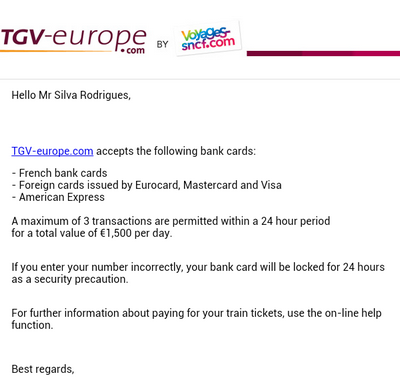
…and I got this reply:

Reply-1

Now doesn’t that make me a happy client? 🙂

Many travelers nowadays are unhappy with air travel, but they don’t really have a choice. Even Deutsche Bahn, while providing a decent booking system, is making international train rides impossible with their price discrimination — charging ridiculously high prices unless you have a contract for their discount cards.

It’s a classic example of going safe instead of going big: railways could snatch long-distance travelers but they choose to target reliable but cheap local customers. It gets worse if you’re an adult. In that case, chances are that travel is important to you: many times you travel because you really have to. Say, because your clients or family need you. Sorry mate but you will have to stick to the flyin’ sausages.

The Majestic Taipei 101 Tower

The Taipei 101 tower in downtown Taipei city was the world’s tallest inhabited building at the time it opened in 2004. I had the chance to visit the area a few times, first to walk about, then for the Xmas experience, and finally to check out the heights and sights up there from the 73rd floor, where the Google office is located.

This slideshow requires JavaScript.


There is a huge, luxury shopping mall inside the tower and many lifts that feel like smooth, silent airplanes going up. It’s quite a thrill, nicely crowning the already exciting walk around Xinyi’s modern neighborhood. Absolutely the number 1 urban experience in Taipei!